
Flow in Dance – Finding Ease, Connection & Growth in Dance
 Reading Time: 5 minutes
 Humans need flow experiences — moments when we are fully engaged, present, and absorbed in what we are doing. Flow often happens when a task challenges us just enough to stretch our skills — not too easy, not too hard — the so-called “challenge-skill sweet spot”.
Dance is one of the places where this balance naturally occurs. For example salsa, mambo, and bachata give us a chance to move, connect, explore new challenges, and loose ourselves in music and movement. This is why we are interested in exploring flow: it’s at the heart of why we dance, why we teach, and why we love the journey of learning and sharing dance.
In dance, there is often an underlying pursuit — sometimes conscious, sometimes not —
of flow. A sense of harmony, naturalness, and beauty in movement. Something that feels good inside the body, and often — though not always intentionally — also appears harmonious from the outside.
In psychology, flow is a state where action feels effortless. You’re fully present, focused, and connected to what you’re doing. You’re not overthinking. You’re not judging. You’re simply in it. Time feels different. Movement happens naturally.
Flow is often described as an optimal state — one where challenge and ability meet in a way that keeps you engaged. When things are too easy, attention fades. When they are too hard, effort turns into struggle. Between these two, flow appears.
Flow in dance is not just one thing
In salsa, mambo, and bachata, flow can mean different things to different dancers — and even to the same dancer at different times. Flow changes as you grow.
What flow feels like for a beginner, for an experienced social dancer, or for a professional teacher is not the same. It can feel different when you dance solo, leading or following. And it evolves over time — from finding continuity in the basics, to handling increasing coordination and complexity, to expressing music with confidence and ease.
For some dancers, flow is continuous body movement.
For others, it’s smooth spins.
For some, it’s musical timing.
For others, it’s connection.
Flow can appear through spins and traveling movement, but also through grounded body movement, connection, and musical timing — especially in dances like bachata.
Flow is not a fixed destination. It develops along your dance journey.
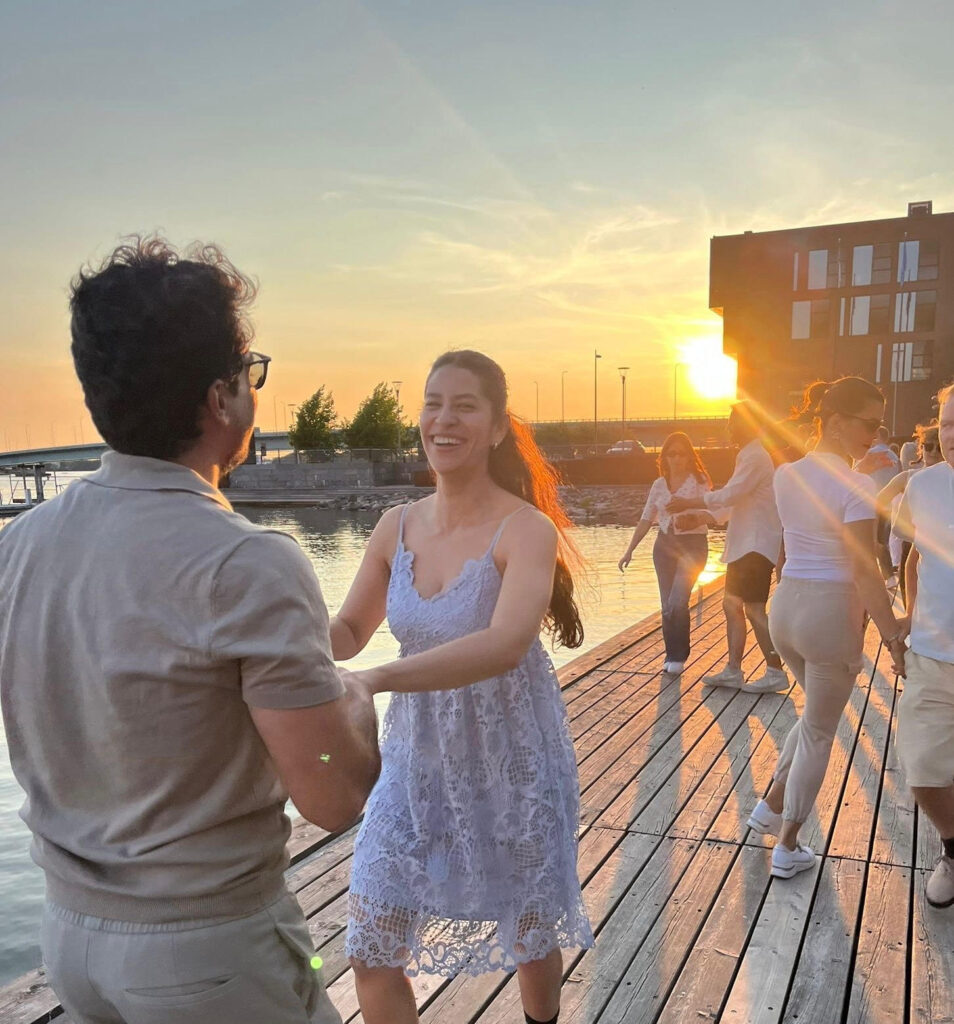
Inner flow and outer appearance
Flow is first and foremost about how dancing feels — inside your own body, and between two people dancing together. In social dance, it does not matter how things look from the outside. And yet, for many dancers — often subconsciously — there is also a wish for the dance to look harmonious, skilled, even beautiful.
These two perspectives are not opposites. When movement feels light, connected, and natural, it often appears that way too — not because it is forced, but because it is balanced.
Flow and challenge
As dancers develop, a natural question appears: Do I need more patterns? More technique? More styling? More complexity?
Growth does require challenge. Flow does not mean staying comfortable. But flow is most likely when challenge is well matched to the dancer.
For leaders, flow grows when patterns are clear, well timed, and connected —
challenging enough to stay engaging, but not rushed.
For followers, flow comes from balance, grounding, and responsiveness —
being invited into challenge without being overwhelmed.
For solo movement, flow develops as coordination, body movement, and musical ideas expand step by step.
Sometimes flow comes from learning something new. Sometimes from refining what is already familiar. The key is not “more” or “less”, but the right challenge at the right moment.
Flow is not about perfection
Flow does not mean dancing without mistakes. Flow often becomes accessible when dancers are not afraid of making them — when mistakes are part of movement, not something that stops it.
Flow breaks when fear takes over. Flow continues when movement continues. It is less about control and more about staying engaged.
What helps dancers move toward flow?
Flow cannot be forced — but it can be supported. Some things that help:
- Progressive technique, introduced at the right time (basics, posture, balance, timing, spin technique, coordination)
- Meaningful challenge, that stretches without overwhelming
- Repetition with intention, so movement becomes embodied
- Body awareness, not just intellectual understanding
- Mental flexibility, allowing effort without harsh self-criticism
- Patience, knowing that flow often appears gradually
When challenge and ability meet, dancing feels energizing rather than exhausting.
You are learning.
You are focused.
You are enjoying the process.
Flow is also social
Flow is personal — but never only personal. It is shaped by:
- classes and how learning is guided
- teachers and how challenge is adjusted
- partners and how they listen
- parties and the atmosphere created by organizers, spaces, and music
When dancers feel supported and encouraged, they are more willing to try, learn, and grow. And that openness is where flow thrives.
Bringing it all together
Flow rarely comes from one thing alone. It emerges when different areas are in balance:
- technique
- timing
- body movement
- leading and following skills
- musical awareness
- connection
At Still Dancing, our teaching philosophy revolves around supporting this balance — helping dancers refine skills, explore challenge, and grow while still enjoying the journey. This balance is created by developing different skills at the right time and offering challenges that support progress without overwhelming the dancer. Perfect flow may be rare and temporary. But learning to dance is, in many ways, learning how to bring these elements closer together — again and again.
A simple reflection
What does flow mean for you right now — at this stage of your dance journey?
Ease in the basics?
Enjoying new challenges?
Deeper connection or expression?
Flow will continue to change as you grow.
And that ongoing search is part of what makes dancing meaningful.
